4. Is liposuction a reasonable treatment for obesity?(top)
 Liposuction is not a good treatment of obesity. Liposuction is not effective, even as a last resort, for people who are unable to lose weight by dieting and exercise. Obese patients almost always regain the weight that is removed by liposuction unless there is a dramatic reduction in calorie intake (by dieting) or a significant increase in calorie expenditure (by exercising). Whenever large-volume liposuction has been used in an attempt to treat obesity by surgery, there has been a significant increase in the incidence of serious surgical complications. It is not safe to remove huge amounts of fat by liposuction. It is dangerous to remove more than 8 to 10 pounds of fat by liposuction in a single day. Thus, liposuction will not be of any significant benefit for an obese patient who believes that liposuction will aid in the effort to lose weight. Liposuction is not a good treatment of obesity. Liposuction is not effective, even as a last resort, for people who are unable to lose weight by dieting and exercise. Obese patients almost always regain the weight that is removed by liposuction unless there is a dramatic reduction in calorie intake (by dieting) or a significant increase in calorie expenditure (by exercising). Whenever large-volume liposuction has been used in an attempt to treat obesity by surgery, there has been a significant increase in the incidence of serious surgical complications. It is not safe to remove huge amounts of fat by liposuction. It is dangerous to remove more than 8 to 10 pounds of fat by liposuction in a single day. Thus, liposuction will not be of any significant benefit for an obese patient who believes that liposuction will aid in the effort to lose weight.
On the other hand, an overweight person whose weight has been stable for many years and has certain problem-areas of fat may be a good candidate for liposuction. Liposuction in an obese patient is reasonable when the goal is to improve a troublesome body contour area. It is not reasonable to use liposuction as a surgical technique for weight loss.
5. What is a successful liposuction surgery?(top)
A liposuction surgery is a success when the patient is happy with the results. The surgeon's goal is to obtain an optimal aesthetic result rather than to maximize the amount of fat removed. One of the most common causes for disappointment in the results of liposuction surgery is the removal of too much fat, which produces an abnormal or unusual appearance. The cosmetic success of a liposuction surgery is often the result of removing an amount of fat equivalent to less than a pound or two of butter from a woman's saddlebag area or from a man's love handle area. While this amount of fat is relatively small compared to a person's total body weight, it does produce a dramatic change in the patient's silhouette.
6. Does liposuction always remove cellulite?(top)
Liposuction improves the silhouette of the body, but does not necessarily eliminate the pre-existing subtle "puckering" of the skin that is often referred to as "cellulite." Liposuction does reduce the degree of cellulite to a degree but it is unlikely to completely eliminate cellulite.
7. Does liposuction produce permanent results?(top)
After liposuction the body's new shape is more or less permanent. If a patient does gain a moderate amount of weight after liposuction, then the figure will simply be a larger version of the new body shape. Fat cells that are removed by liposuction do not grow back. As long as the patient does not gain excessive amounts of weight, the new, more pleasing silhouette is permanent. Of course after liposuction the clock keeps ticking, and advancing age will produce the usual changes in the shape of the body associated with the aging process. If a person gains weight after liposuction, she/he will not accumulate as much fat in the treated areas as would have happened if liposuction had not been done.
8. Does the fat come back in other spots after liposuction?(top)
If a patient does not gain weight after liposuction, then fat does not accumulate in other areas of the body. However, if a patient gains a significant amount of weight, say more than 10 pounds (5 kg), after liposuction, then the fat must go somewhere. In fact, the fat accumulates in every area of the body in proportion to the amount of fat cells in each area. Areas where fat cells have been removed by liposuction will accumulate relatively little fat, while areas not treated by liposuction will collect relatively more fat. For example, if a woman gains weight after liposuction of her hips, outer thighs, and abdomen, then most of the fat will be deposited elsewhere such as the woman's breasts, face, back and legs.
9. Does liposuction cause dimpling or indentations in the skin?(top)
Dimpling and indentations in the skin is a known risk of liposuction. However skin irregularities are unusual in the hands of a skilled surgeon. The use of large diameter cannulas tends to increase the risk of irregularities, while the use of microcannulas (less than 2.8 mm in outside diameter) reduces this risk. The use of microcannulas and multiple adits (very tiny 1.5 mm round holes placed in the skin) allows the surgeon to make a criss-cross pattern of tiny tunnels throughout the fat which produces smoother liposuction results compared to using larger cannulas and only two or three entrance incisions. When large cannulas are used, any inadvertent passage of the cannula too close to the skin may leave a depression or furrow, whereas one pass too close to the skin with a microcannula will not leave a visible depression.
10. What Alternatives Are There to Liposuction?(top)
Liposuction is never absolutely necessary. If you decide that liposuction is not for you, then you may consider the following alternatives to liposuction. Weight loss without liposuction can produce excellent aesthetic results. Weight loss can be achieved by dieting (decreased calorie intake) or by increased exercise (expenditure of calories). An alternative to abdominal liposuction is a tummy tuck.
FAQ: Liposuction Techniques and Instruments
1. How many incisions are made?(top)
The number of linear incisions or adits (tiny round holes) that are placed in the skin is determined by a number of factors including size and location of the area being treated, and the surgeon’s technique. In general, when just a few (2 to 6) incisions are used in an area, the incisions tend to be somewhat larger (greater than ¼ inch long), and are closed with stitches. In contrast, surgeons who use small diameter microcannulas typically make multiple (4 to 12 or more) tiny adits in an area, which are so small (less than 1/8 inch in diameter) that no stitches are required.
2. How long will take for the incisions to heal? (top)
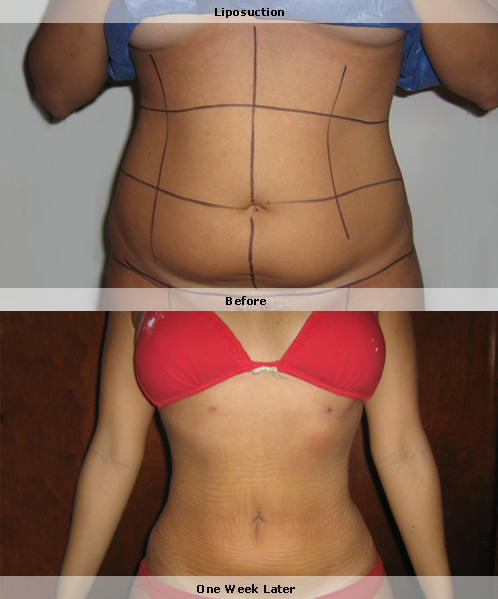
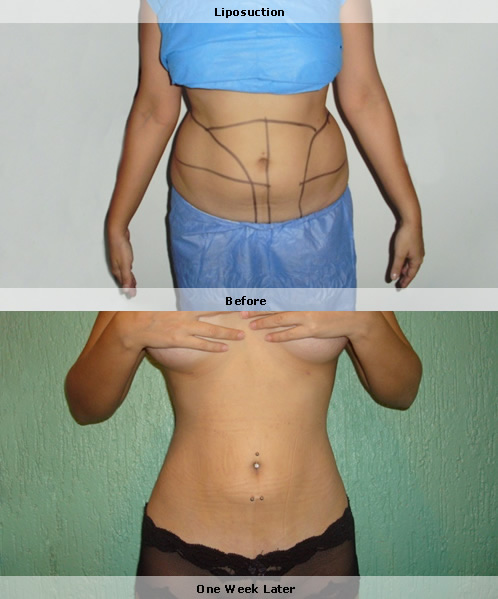
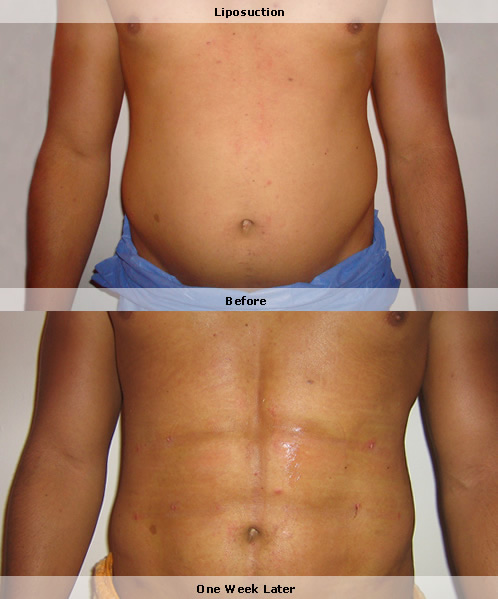
Incisions or adits usually close up in a week or two, and become completely healed with no scabs within 2 to 4 weeks. The incision sites slowly become less and less visible over 3 to 12 months, except in patients who have darkly pigmented skin, in which case the incision sites may remain visible for more than a year or two.
3. Is it necessary to have an IV during liposuction?(top)
Intravenous fluids are not necessary, and in fact are contraindicated with tumescent liposuction because the large volume of dilute tumescent local anesthetic fluid that is injected under the skin is sufficient to replace any fluid that is lost by liposuction.
4. How long does it take to complete a typical liposuction procedure?(top)
The average patient will be in the surgical facility for 3 to 7 hours. However, the actual surgery may only require 2 to 3 hours. The length of time that it takes to complete a liposuction depends on the size of the patient, the number of areas being treated, and the type of anesthesia being used. Because it takes a certain amount of time to inject local anesthesia, it usually takes longer to do liposuction using local anesthesia than it does using general anesthesia.
5. What is the safest form of liposuction?(top)
Tumescent liposuction totally by local anesthesia is the safest form of liposuction. Liposuction using general anesthesia or heavy IV sedation is somewhat less safe than liposuction totally by local anesthesia. The greatest danger of using general anesthesia or heavy IV sedation is that these forms of systemic anesthesia permit a surgeon to do too much liposuction on the same day and permit multiple unrelated cosmetic procedures on the same day as liposuction. If a patient desires a large amount of liposuction, or multiple unrelated cosmetic surgical procedures, it is safest to do the liposuction on two or three separate occasions, each separated by three to four weeks, and to not do unrelated surgical procedures on the same day as liposuction.
6. What is a liposuction cannula?(top)
Microcannulas permit smoother results after liposuction. A liposuction cannula is a small stainless steel tube that is inserted through an incision in the skin and removes subcutaneous fat. The fat is suctioned through the cannula, then through a long flexible plastic tube that attaches the cannula to a vacuum pump.
7. What is a microcannula?(top)
Tumescent liposuction totally by local anesthesia requires the use of very small cannulas or microcannulas. Microcannulas have an outside diameter = 2.8 mm. Microcannulas permit a more delicate and gentle approach to liposuction than can be achieved using larger cannulas. Because microcannulas require a minimal amount of force to be pushed through fatty tissue, the surgeon can control the direction and position of the cannula with much more accuracy: The ultimate result is a greatly reduced risk of inadvertently approaching too close to the undersurface of the skin and unintentionally causing irregularities.
8. Is the ultrasonic assisted liposuction (UAL) technique safe and effective?(top)
UAL is neither as safe nor as effective as traditional liposuction. See Risks of Ultrasonic Liposuction.
9. Is power-assisted liposuction (using oscillating or vibrating cannulas) safe and effective?(top)
Power assisted liposuction (PAL) uses a machine-powered cannula that oscillates in and out or vibrates very fast. PAL is relatively new and somewhat controversial. Manufacturers of these devices and some surgeons are enthusiastic about PAL and believe it makes liposuction easier. Other surgeons remain skeptical and have not found there to be any advantage in using PAL.
FAQ: Post-Op Pain and Discomfort
1.Post liposuctions pain, how long will I be sore?(top)
Every person has a different post surgery pain tolerance, but the general reactions for the first 48 hours, most post liposuction patients will stick close to bed. A general feeling of being hit by a heavy flu is a good way to sum up what most patients experience. Make sure to clear up your schedule before the procedure, so you can rest. Most liposuction patients report feeling 80 percent better by day 3.
2.How extreme is the pain after liposuction surgery?(top)
First off most patients do not describe liposuction recovery as extremely painful! At most, patients report of extreme discomfort 12 to 72 hours just after surgery. Perhaps the most difficult pain complaint is related to not being able to get comfortable to sleep (this depends on where your lipo was performed of course). After the 48-72 hours the discomfort is all downhill from there. A skilled plastic surgeon with years of experience, combined with a first rate anesthesia, you will be in good hands, Remember less pain is experienced with local liposuction anesthesia.
Pain immediately following liposuction is very manageable when local is used, The drugs used for the local stay in the body area and system and contuse to provide relief for some time (up to 24 hours). Typically your plastic surgeon will prescribe mild pain medication or sometimes only Tylenol. Where extreme reactions come into play is when general is used and insufficient local anesthetic (Lidocaine) is used. Your surgeon will guide you through both of the options if they use both techniques.
3.Do the liposuction garments (compression) help with pain?(top)
Your liposuction garment, con help with post surgical pain if your surgeon is using open drainage systems. The open drainage means the hole the surgeon to remove the body fat from is left open with a small drainage left to help excess fluids drain during the healing process. After your skin reattaches and starts to mend, the drainage is removed. Most liposuction patients also feel that the compression garments makes them feel more secure after the procedure.
4.How long will I have to stay in bed after liposuction surgery?
(top)
You will not be bed ridden after surgery, in modern liposuction methods the patient is asked to walk around and have some level of movement after surgery. That being said post surgery; you will be very tired and want to stick close to your bed for the first day or so. You can expect to be cleared to go back to work (job dependant) in about 24-72 hours. If your surgeon chooses local vs. general anesthesia you can expect to be up and about much faster than the latter. Also general recovery time is also reduced overall.
 Back to Plastic Surgery Back to Plastic Surgery
|




 Learn more...
 Related:
 What does this price include?
 File ID : Q&A
  SSI_Answer